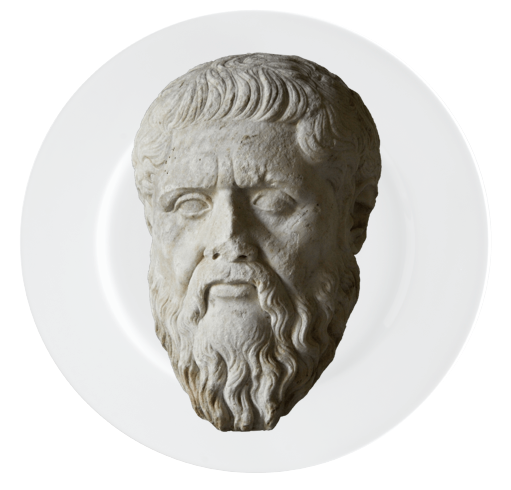
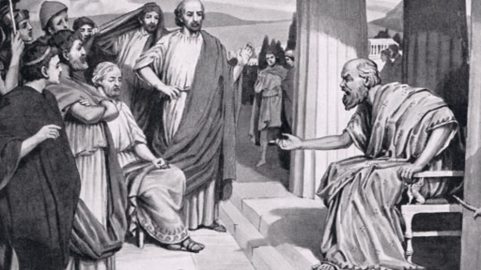
Socrates has been brought before the court of Athens on the charges of impiety (blasphemy) and corrupting the youth of the city. Whilst you might expect that a man who is in danger of being sentenced to death might plead with the jury, or proclaim his innocence in ‘apologetic’ terms, Socrates does just the opposite, and launches a passionate speech accusing his own accusers of hypocrisy and not caring for justice or virtue. But is it the right approach, and will it get him off the hook?
The Apology digested: part 1
Socrates: People of Athens! I have no idea how those that have accused me of these charges have got into your heads and tried to set your hearts and minds against me. I expect they warned you to be careful of the fact that I’m an accomplished speaker, and that I might trick or deceived you! But sorry to disappoint: I’m a terrible speaker. All I speak is the truth, and I’m here to tell it to you.
I’m an old guy for god’s sake: 70 years old, and this is my first time in court. I’m just going to tell it like it is. People around here have been slagging me off for years; all falsely, by the way. For example, that bastard Aristophanes, in his ridiculous play The Clouds, has tried to slate me in a load of nasty ways. Some people have been doing it for years; others more recently. I’ll start with the first lot first.
Aristophanes and other like him accuse me of talking a load of rubbish about a load of things, like which end a gnat farts out of. Fascinating, I’m sure, but I know nothing about farting. Really! Also, they have accused me of peddling my supposedly nonsense teachings for money in the city, like those arsehole ‘Sophists‘ that you hear so much about. Well, good for them if that’s how they want to earn their money. I myself couldn’t do this even if I wanted to: because I know nothing!

But you know, I didn’t believe my own brilliance and wisdom at first, even thought the Oracle had told me. So I tried to find some people who were wiser than me. But when I spoke to each, I realised that really, they were all idiots! They knew as little as me: which was to say: nothing! But at least in my case, I was aware of my own ignorance, whereas they actually thought they were wise! So that proves it: I really WAS wiser than them, and the Oracle was right. Which just goes to prove my favourite saying: the wise man (i.e. ME, obviously) knows he knows nothing. So I can have my cake and eat it too.
Anyway, all this questioning people’s wisdom has, I admit, made me a bit unpopular. I get it: it’s really annoying. And I’ve done it everywhere: I’ve questioned politicians, poets and craftsmen, and it turns out they’re all idiots! Especially those with the best reputations for being wise. But I get it: being brilliantly wise as I am makes me really annoying. But I can’t help it! It’s how I am, and it’s how I will continue to be, because it’s what the gods want me to do. And how can you argue with that! And it’s clear that the people I expose for being idiots resent me, and are the source of these accusations against me. So on the accusations from them that I ‘corrupt the young’, I rest my case that it’s a load of bollocks, and that’s that.
Now for the people who have been accusing me more recently. Meletus, for example… oh actually, here he is in this court! Well this could get awkward … Meletus, you’d say that it’s important that the young men of Athens are good and as well off as possible, right?
Meletus: (slightly taken aback that he’s been picked out by Socrates) Well, yeah, I guess…
Socrates: And who or what makes these men better off in our society?
Meletus: Well, these people of the jury here for a start….
Socrates: Ok, and what about the audience here too?
Meletus: Yep, them as well…
Socrates: And everybody else too, right? All the inhabitants of this city all make the young men of Athens better off. Everybody except me, I suppose?
Meletus: Actually, yes! You are the problem! That’s why we’re going to have you put to death!
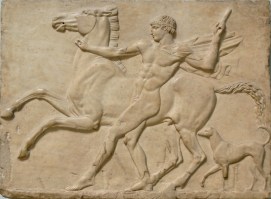
Socrates: Well THAT’S a load of bollocks, because with everything else, for example horses, only one person (the horse breeder) makes them better off, and most other people corrupt them! And the same is true of all other animals, and humans. So you’re obviously talking out of your … hat.
Meletus: Umm….
Socrates: And following on from this, do you think that any man intentionally wishes to be harmed by another?
Meletus: Well, obviously not.
Socrates: Well you’ve disproved your own case then, since if I really WAS going around corrupting the young, I would be running the risk of being harmed in return, and as you’ve said, no person would deliberately do that. [Turning to the crowd]: People of Athens! It’s clear (from the extremely convincing and water-tight argument that I’ve just presented) that Meletus is talking a load of rubbish when he accuses me of corrupting the young. He also, by the way, accuses me of being an atheist of all things! But this doesn’t make sense, for I am well known for believing in spirits, as Meletus knows. Isn’t that right, Meletus?
Meletus: Well, that’s what I’ve heard.
 Socrates: Well the idea of an atheist believing in spirits is absurd, since as everybody knows, spirits are the children of the gods! Come to think of it, the idea of an atheist being spiritual at all is itself absurd! Just look at Richard Dawkins: he’s cold inside. And what about Alain de Botton: isn’t he a so-called ‘spiritual atheist’? Well, yes: so it follows that he is absurd. Which of course, as everybody knows, he is.
So I have proven beyond doubt that I am neither a corrupter of youth, nor am I a blasphemous atheist. But seriously now: it’s tragic that in this world, standing up for your beliefs can lead to danger, and even death. Look at me: here I stand in court, possibly facing a death sentence for simply living according to the highest ideals of virtue, truth and wisdom. But it is always better to live authentically and carry on sticking to your principles in times of danger than to bow down to those who try and bring you down, and live a pathetic existence because of it. Partly because to fear death is irrational: we simply don’t know what death involves. It is not wise to fear death: it might be good, it might be bad, we just don’t know. So you see, out of ignorance comes wisdom: the wise do not fear death, BECAUSE they are ignorant of it. So don’t think about acquitting me on the condition that I change my annoying, questioning philosophical ways. I will NEVER do this. I will continue to teach people that the best thing to do in life is to care for your soul and live a life full of virtue, rather than pursue money or anything else. I will do this regardless however dangerous it is for me to do so or how much I am threatened.
And if you, people of Athens, do put me to death, you’ll only be harming yourselves. I’m a gift to this city! I only follow the truth, and the voice in my head, my ‘divine sign’ that guides me away from things I shouldn’t do, like deliberately cause a stir in public with my ideas. In all of my public and private dealings, I have acted justly: and by the way, I’m not responsible for those looneys who have heard my words and done things that I never said were ok! Because I feel I am increasingly being held guilty through my association with these people.
OK; so I have established that whilst I am an extremely annoying philosopher, I am not guilty of any of your charges, and am both wise and committed to living a perfectly just life. Look at all these people here who have enjoyed my conversation over the years; I must be wise, or else they would have abandoned me years ago, since I am simply unbearable to be around at the best of times. There must be something in it for them! I’m the most irritating man in Athens!
So, to sum up for now, some of you may be wondering why I haven’t come in here pleading my innocence, or meekly promising to ‘be good’ from now on on your terms. ‘My poor children, won’t somebody think of the children!’ I could have begged. THIS would have truly been unholy and impious, which is the very thing I’ve been accused of. But as you can see, I am neither. And having proven this, I expect you’ll all just… let me off now? Please?
More ideas
What kind of ‘apology’ is this?!?
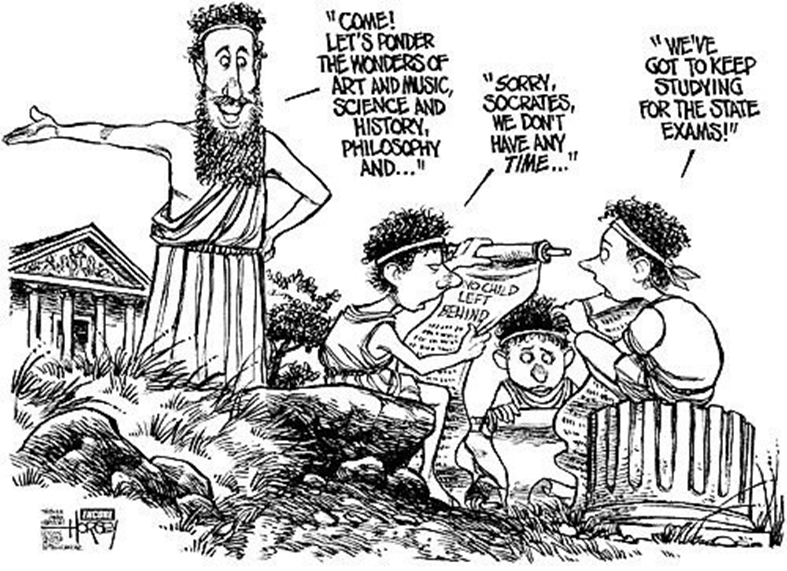
Though we might expect the ‘apology’ of Socrates to be a grovelling attempt to get out of what could be a death-sentence at the hands of the Athenian court, what Socrates produces is anything but. ‘Apologia‘ in Greek just means a ‘defence speech’, though this is no ordinary one. Though the language of my re-imagining of the first half of Socrates’ defence speech is adapted, the tone has (honestly) been kept pretty similar. Socrates moves quickly and unpredictably from sincerely proclaiming his innocence of the charges, to throwing accusations back at the jury and audience, and furthermore to openly insulting his accusers and at points even giving the sense that he is resigned to his fate. This has been taken as evidence that what we have here is a highly idealised account of the actual historical event, in which Plato attributes to Socrates a range of views and opinions which he either held but did not utter in such terms, or which Plato wish he had. Curiously, some of Socrates’ arguments and attempts to logically disprove his accusers, particularly Meletus, are hopelessly weak. This speaks to the real aim of the ‘dialogue’ being to simply put forward in an engaging way the ethos of Socrates himself: a passionate, unconventional but ultimately heroic philosopher who vows to live an authentic life and refuses to abandon his principles even when faced with death.
Wisdom consists of being ignorant
The Apology is one of the sources of a phrase often attributed to Socrates: ‘the wise man knows he knows nothing.’ This is perhaps deliberately playful and paradoxical on the part of Plato, but has a serious message behind it. True wisdom, for Socrates, consists of being conscious of what you don’t know; it is to see the world as a sea of complex and competing opinions, ideas and principles which need to be carefully distinguished and sifted through in order for a person to reach the truth and live a meaningful life. The world is not black and white for Socrates, and people who claim knowledge where they have none (for example politicians, whose sole aim is to propound the flawed ‘black-and-white-ist’ world view) are the truly ignorant ones.
Should we fear death? Does Socrates fear his sentence?
Socrates presents an interesting argument in this section of the Apology for why death should not be feared. Riffing off the ‘wisdom from ignorance’ idea, he argues that it is irrational to fear death, as this would be to presume that we know that death is a bad thing, and therefore claim knowledge where we have none. Since we are ignorant of what happens after death, we should not entertain such fears. As Socrates states in the actual dialogue:
“No one knows whether death may not be the greatest of all blessings for a man, yet men fear it as if they knew that it is the greatest of evils.” Source
I wonder whether the reader of this post is comforted by Socrates’ insistence that death shouldn’t not be feared. And I wonder whether this argument gives a clue as to how Socrates could predict his trial would end. Come to think of it, is the Apology so far an attempt to be acquitted in any real sense at all? And is it obvious at this point (for those who don’t know the story) whether the jury will acquit Socrates or not?
Disclaimer
This dialogue has been abridged and re-worded, with some silly bits added, to make the key arguments more accessible and engaging. It doesn’t represent a totally accurate re-telling of Plato’s original (which can be read here). However, it is designed to preserve the key basic thoughts and arguments, as well as giving a sense of some of the fascinating philosophical issues that Plato addresses in this dialogue.
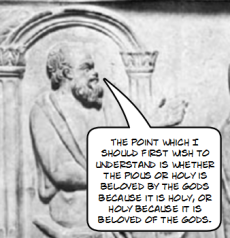
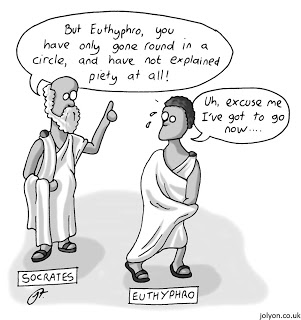
 Socrates has been accused of insulting the gods and corrupting the youth of Athens, and seems determined to prove his innocence. He meets his friend Euthyphro, who believes himself to be somewhat of a prophet and a sage when it comes to the nature of the gods. Socrates has a chat with Euthyphro in an attempt to get to the bottom of what the nature of holiness really is, hoping that this knowledge will help him prove his own holiness, and innocence, in court. But it turns out that Euthyphro has a tricky court case of his own, and also that holiness proves annoyingly difficult to define….

 Plato Digested