The Apology (2/2) – Socrates’ verdict

b62e66d658329f1141b7dd9ae599c240fc15301660d3b1bb2ba21ea76dc8db6c

After making his not-very-apologetic apology to the Athenian jury and audience, Socrates prepares to face their verdict, on charges of blasphemy and corrupting the young. He tries and fails to appeal against their decision, and then like a true philosopher, prepares to face his fate…

Before reading this… have you read the Apology digested (part 1)?

The Apology digested: part 2

Athenian jury: Our verdict is…. guilty of all charges!

Meletus: Excellent! I recommend for Socrates the worst punishment of all… death!

Socrates: (sighs) Well this was not unexpected. I suppose I deserve it for being such a lousy speaker. I did warn you… but hey! I was expecting the verdict given to have a much greater majority!

(To the Athenians): Anyway, it doesn’t matter. Meletus recommends death. So be it. What alternatives do we have, now that you have decided me (wrongly, by the way) to be guilty as charged? Well, I deserve to be treated like a man who has neglected the usual pleasures of wealth, a job and social status in favour of caring for the thing that truly matters: the state of my soul, and teaching others to think the same. I’ll tell you: free dinner every night in the town hall! That’s what I truly deserve. I have literally spent my life trying to make other people – YOU – better. So that’s my recommendation. Instead of the death penalty: free meals for life! Digest that for a minute.

I presume you’re thinking even nastier thoughts about me than you already were, people of Athens. If only we had more time… I could easily convince you of my innocence. This trial has only lasted a day! But it’s irrelevant now. Shall I protest going to my death, the certainty of which we’re already seen is no reason to be afraid? Or shall I plead for a miserable life in prison or in exile, which will certainly be fearful? No, of course I won’t. Prison is miserable, and if I live out my last few days in exile, I’m damned either way: both for turning people away, and for continuing to teach them how to live, I’ll be hunted down. Could I live a quiet life away from it all? No. I can’t keep quiet when I am convinced that the only way to live is a life of virtue, a large part of which involves constantly talking about it to anybody who’ll listen! The un-examined life is surely not worth living at all.

But hey; let’s have one last go. I’ve made it pretty clear that I don’t deserve any punishment, still less the harsh punishment recommended by Meletus. So how about I pay my way out of this? I’d say that… hmnn….€2,300 seems about right for me. I don’t have this money, of course, but wait … my mates Plato and Crito say that they’ll round this up to what they suggest is a more persuasive sum of €70,000. They’re good for it, so how about… you….set me free? Please?

Athenians: The sentence is death!

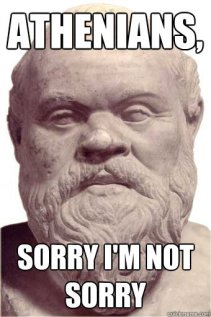
Socrates: You will regret this day! You will all regret it, and you will feel the incurable guilt that comes with the knowledge that you have killed me, Socrates, the wisest man in Greece! Even those who don’t actually think I’m very wise will say so now, as you will make a martyr out of me with this ridiculous verdict! You have convicted me today not because I failed to persuade you, but because I didn’t lie down like a dog and tearfully Image result for a pig satisfiedaccept your demand to live a boring, quiet and obedient life, like a pig. Well, I would rather die than live this kind of life. It is hard to avoid death, but it is even harder to avoid wickedness, which I see has caught up with you idiots as quickly as death has caught up with me.

Maybe it was always going to be this way. But as I’ve said: by killing me, you make my philosophy stronger. Now even more people will bother you like I did, and you’ll understand that it’s always better to bettering yourselves rather than discrediting others.

And with this prophecy, my apologia ends. But let’s stay and chat awhile, you bastards! Nothing prevents us from talking, and I am determined to do this until the very end. And to my friends, I say that it is some comfort that the fate to which I now go seems best. Let’s hope that death is a blessing, rather than a curse, though as I’ve said, we don’t rightly know which one it is, good or bad. I know one thing: either death means no perception of anything at all (like a dreamless sleep), or it means going to another place, like an afterlife. If it’s nothingness, well, I can live with that. A dreamless sleep is better, as you know than most nights, and even some days! And if there is an afterlife, where everybody who has died is not living, well what a great thought THAT is! The underworld, if a place like heaven, would contain all the Greek heroes from the myths, and wouldn’t it be nice to hang out with them. And if instead the underworld is like a kind of hell, I could question and annoy all the people there who have suffered unjust punishment, just like me. Either way, I could carry on my philosophical questioning of people free from punishment by all of you arseholes! Who wouldn’t want to meet all their heroes in heaven or hell? So actually, it’s all looking quite good…

So to conclude, things are actually looking up. Now the hour to part has come. I go to die, you all go to live. Which of us goes to the better lot is known to no one, except God.
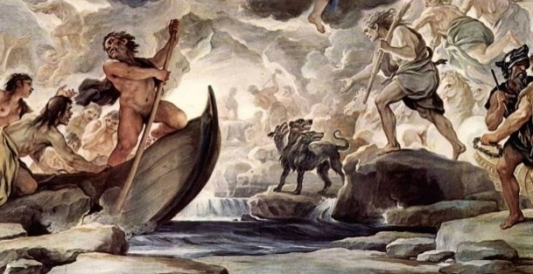
art-in-detail-the-greek-underworld-part-1-deities-25-638
What kind of afterlife will Socrates go to? And will he meet others there to question and annoy?


More ideas

Is Socrates really convinced that his death is the best option?

Following on from his thoughts about death in the previous part of his speech, Socrates seems to have convinced himself that it’s better off for him to die rather than grovel with the authorities and lead the kind of inauthentic and ultimately meaningless life that they might expect of him. Plato’s Apology thus turns out to be a rather passionate and moving treatise on the meaning of life, the nature of death and how to come to terms with it, and the importance of never giving in to those who would deny you an authentic existence, whatever the cost. This thought is later brought up in the Phaedo, in which Socrates faces his own demise and muses that the proper aim of philosophy is the ‘art of dying well’, rather than primarily the art of living well. We may well agree with him, and this is one of many passages in Plato that has a striking timelessness to it. The great insight here is that we rarely choose how and under what circumstances we die; the only thing we can do is to face our death with courage and without fear, knowing that we really don’t know what’s beyond the grave, and that we should try to be happy for the life that we’ve lived.

However, it could be argued that this is a noble but rather idealistic account of the proper way to approach one’s death. Could Socrates really have convinced himself that his death was welcome, to the extent to which he went to it gladly, and with no horror or fear at all? Is it even psychologically possible for a person to engage in reason and argument (as Socrates seems to do) to achieve such a sanguine and admirable outlook on one’s death? And if he was so prepared to meet his fate in this way, why did Socrates even bother to give the Apology at all, much of which seems laced with disdain and righteous indignation at the Athenians who brought the charges against him? These points, coupled with Socrates’ lame attempt to pay his way out of his punishment, suggest that perhaps the great philosopher wasn’t as ready to meet his own death as he made out. And we can hardly blame him, consoling though his words certainly are.

Image result for hemlock

Disclaimer

This dialogue has been abridged and re-worded, with some silly bits added, to make the key arguments more accessible and engaging. It doesn’t represent a totally accurate re-telling of Plato’s original (which can be read here). However, it is designed to preserve the key basic thoughts and arguments, as well as giving a sense of some of the fascinating philosophical issues that Plato addresses in this dialogue.
Euthyphro – the mysteries of the gods

socratesSocrates has been accused of insulting the gods and corrupting the youth of Athens, and seems determined to prove his innocence. He meets his friend Euthyphro, who believes himself to be somewhat of a prophet and a sage when it comes to the nature of the gods. Socrates has a chat with Euthyphro in an attempt to get to the bottom of what the nature of holiness really is, hoping that this knowledge will help him prove his own holiness, and innocence, in court. But it turns out that Euthyphro has a tricky court case of his own, and also that holiness proves annoyingly difficult to define….


Euthyphro digested

Euthyphro: How’s it going, Socrates?

Socrates: Not so good, actually. I’ve been accused of corrupting the young men of Athens, and will have to prove my innocence in court! This is obviously nonsense. I fear that I’ve been accused wrongly, and am for the chop!

Euthyphro: Sounds serious. But from what I’ve heard, you have been saying controversial stuff about the gods, and even making up your own. Perhaps it’s all your talk about your ‘divine sign’ that follows you around. You know how touchy the authorities in Athens are: they’re not too keen on people like you challenging the status quo. You’ve been playing with fire there, you know.

Socrates: I guess you’re right.

Euthyphro: Anyway, I have a court case of my own to deal with, you know. Except in mine, I am the prosecutor rather than the accused!

Socrates: Really? Who have you accused?

Euthyphro: You’ll think me crazy, Socrates, but it’s my dad!

Socrates: Are you crazy? Why?!?

Euthyphro: To cut a long story short, one of our servants killed one of our slaves. My dad flew into a rage and had the servant tied up and left in a ditch; the poor guy later died. So my dad’s a murderer! I know what you’re thinking…. how could I betray my own dad on behalf of a slave? But I won’t hear of it. Justice is justice, regardless of whether the criminal is my dad or whether the victim is a slave. He’s done something really bad, so it is the right thing to do for me to bring him to justice!

Socrates: I’m glad to hear you say that, because I could do with knowing a thing or two about holiness right now… and you seem to know a great deal about it. Tell me: what do you mean by ‘holy’?

Euthyphro: Well… I’m currently being holy by charging my dad with murder! Besides, Zeus killed his own father, and he is a god, and therefore extremely holy. So that proves it. I know all about the gods, you know.

1359585362-greek-god-zeus-psd47915
Zeus delivered swift justice on his father, Cronus, for swallowing him and his brothers Hades and Poseidon. By killing him. And also castrating him.

Socrates: So what you seem to be saying is that holiness is simply doing what the gods love?

Euthyphro: Yeah, that sounds about right. What is holy is what is loved of by the gods, and what is unholy is the opposite. Makes sense, no?

Socrates: Sounds good! But hold on… don’t the gods argue and fight all the time?

Euthyphro: Yeah, I guess so. They’re not perfect, you know. We all have disagreements from time to time.

Socrates: Sure, but that means that gods must disagree on all sorts of things. So what the gods love and hate is a matter of disagreement among them: some gods might say that a statue of Hera is more beautiful than a statue of Aphrodite, for example, but others may disagree. I can certainly imagine Hera and Aphrodite disagreeing strongly on this!

Euthyphro: I suppose so… where are you going with this?

Socrates: Well, if what is holy is what the gods love, and if the gods argue and disagree all the time, doesn’t it follow that what is holy changes too? And this make no sense: either an action or a person is holy, or it isn’t!

Euthyphro: Well… yeah…. but…. well, all the gods definitely believe that me prosecuting my dad is holy. So there we go.

Socrates: Even if that’s true, you haven’t answered my original question. I want to know what holiness is in general: I want to know its nature! You haven’t told me this yet; we’ve seen that the explanation you already gave doesn’t make sense.

Euthyphro: Well how about this then: something is holy if it is loved by all the gods.

Dilemma
The famous ‘Euthyphro dilemma’, which poses a problem for anybody who believes in a good god(s)

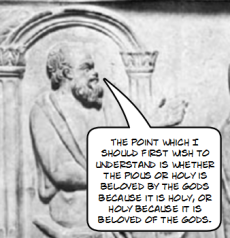
Socrates: Right-oh. So here’s one for you then: Is something holy because it is loved by the gods, or is something loved by the gods because it is holy?

Euthyphro: ….ummm….. what?

Socrates: Well it’s a bit like this. We call something ‘loved’ because it is being loved by something or someone, right? As in, I would say that my pet cat Purrthagoras is ‘loved’, because I love him!

Euthyphro: Makes sense. He’s a great cat.

Socrates: Yes. And you say that being holy is about being loved by the gods. But I’m asking: is something holy because it is loved by the gods? Or do the gods love something because it is holy?

Euthyphro: Well, I would say the second. The gods love things because those things are holy. The gods thus love me prosecuting my dad: because it’s the right thing to do!

Socrates: But in that case, what is holy cannot be the same as what is loved by the gods. We’ve seen that holiness and what is loved are different. As you just said, holy things are loved because they are holy. But things loved by the gods are loved because they are loved by the gods! Just like I love Purrthagoras. So what is holy cannot be the same as what is loved by the gods. As you have just seen, they are different. We’re still no closer to knowing what holiness is!

Euthyphro: Waa….. my head is spinning round and round, just like this discussion. You make these ideas go round and round with your reasoning and logic, and we can’t reach a conclusion!

Socrates: Let’s not give up right away. I still want to know about holiness, and maybe you can teach me yet. Would you say, for example, that everything that is holy is also just? Like you banging up your dad: it’s holy and therefore an act of justice?

Euthyphro: (losing patience) *sigh*. Yes, Socrates, as I’ve already said….

Socrates: Ok. Then would you also say that everything that is just is holy?

Euthyphro: I don’t follow…

Socrates: Pull yourself together, man! It’s not hard. Here’s an example. All cats are cuddly: like my Purrthagoras. Especially him. But not all cuddly things are cats. For example, a friend of mine has a dog called Dogenes. Dogenes is pretty cuddly…. but he’s not a cat. He’s a dog. So I was asking whether, given that all holy things are just, whether all just things are also holy.

Euthyphro: Ah, ok, I get it now. I’m not sure….

Socrates: Perhaps we could say that all holy things are just, but not all just things are holy. For example, it seems just for me to try to do my job well as a professional philosopher (and generally irritate people with endless questioning), but it doesn’t have much to do with holiness. So, holiness is simply one part of justice.

Euthyphro: Yep…..

Socrates: So we need to specify what part of justice holiness is, and then we’ll have found what we’re looking for! A definition of holiness. Any ideas?

Euthyphro: Well we could say that holiness is the part of justice that cares for the gods. The rest of justice is concerned with caring for men.

Socrates: Makes sense. But by ‘caring’ do you mean as a cat-sitter would care for a cat? And like a dog-sitter would care for a dog?

Euthyphro: I guess so…

Socrates: Well, I’m not sure that’s right. Caring means making better the thing you’re caring for: I make sure my cat-sitter makes Purrthagoras better by pampering him whilst I’m away annoying people with my philosophical questioning in other cities, for example. But we couldn’t possible care for the gods this way: there are no ways that us mere mortals can make them better. They’re the gods!

Euthyphro: It seems so. I guess when I said ‘care’, I had in mind a kind of service to the gods, rather than looking after. The kind of care servants take of their masters.

Socrates: Ok, so we’re like servants to the gods. Like a service to a ship-builder would be to produce a ship. So what kind of things do we do in service to the gods?

Euthyphro: Well that’s an easy one. We pray to them, and we sacrifice to them! So being holy means to have a kind of knowledge of how to pray, and how to sacrifice.

Socrates: Oh, crap.

Euthyphro: …. what now?!

Image result for cat png

Socrates: (shakes his head) I sense that we are no nearer to our definition…. let’s see. Holiness, according to what you have said, is a kind of trading with the gods. We offer things to them in sacrifice, and we also beg things from them in prayer. But proper gifts must benefit those who receive them: Purrthagoras benefited greatly from his last meal of kitty treats: he told me himself! How do you think sacrifice benefits the gods?

Euthyphro: Well, it at least gives them honour, reverence and prase, Socrates! What could be more pleasing?

Socrates: ah-ha! So you say that what is holy is what is pleasing to the Gods?

Euthyphro: Most certainly! Wait…….

Socrates: Can’t you see that what is pleasing to the Gods is the same as what is loved by the Gods? You’re saying that holiness is what is loved by the Gods! We’re right back where we started.

Euthyphro: (looking at his watch): apparently so….

Socrates: (smugly) So we’ve got nowhere. But I’m still super keen to find out what holiness is! So let’s begin at the beginning… tell me again what you think…..

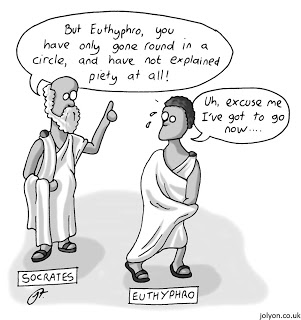
Euthyphro: (interrupts him) Actually mate, I’ve got to go…. erm…. to see a man about…. a dog. Some other time? (Walks off, shaking his head).

Socrates: What! Wait! Come back! Now I’ll never be able to escape from my accusers!

euthyphrocartoon

More ideas

Should a man condemn his own father to punishment (or even death) for killing a stranger?

This is an interesting moral question raised from Euthyphro’s own tale of his father. Euthyphro is clear that a crime is a crime, no matter who commits it; but is he really duty bound to prosecute his own father? Would Euthyphro have been justified in turning a blind eye to his father’s crime simply because it was his dad?  Did his father in the story have an honest justification for punishing his servant for the death of his slave? And did his father’s killing of the servant (justified or not) count as murder, since the servant died later on, and was not killed directly?

What is the relationship between God and morality?

A passage of this dialogue has become one of the most famous in all of Western philosophy. It is called the ‘Euthyphro dilemma’, and can be found when Socrates says the following:

“For consider: is the holy loved by the gods because it is holy? Or is it holy because it is loved by the gods?” Source

Though this dilemma serves no great purpose in the dialogue other than to advance Socrates’ argument and eventually show that no good definition of holiness has been found, the dilemma has been extremely influential in later thought, particularly in the philosophy of religion. Christians believe in an omnibenevolent (perfectly good) deity; however, Socrates’ question here raises a serious problem for any Christian (or any theist for that matter) who believes that an omnibenevolent God exists. This is because either ‘horn’ of the dilemma is problematic for the theist. If what is holy/good is good because it is loved by God, then goodness (and evil) become largely arbitrary, and based on what God decides to love at any particularly point. This makes a mockery of traditional Christian morality, which generally is assumed to be objective, absolute and meaningful. On this picture, God could decree that he loves murder tomorrow, and it would follow that murder is therefore good; which doesn’t seem right.

Alternatively, if God loves what is holy/good because it is good, then it follows that there is an objective standard of morality independent of God, and God simply follows this standard. For theists who take the traditional view of God as an all-powerful creator and necessary being (which is most theists), this is a problem: God cannot be an all-powerful creator or necessary being if there exist objective moral standards independent of him. Plato himself (through Socrates) seems in the dialogue to consider this second ‘horn’ of the dilemma more acceptable, but perhaps this is because Plato and his Greek counterparts were entirely comfortable with the idea of objective values existing independently of God/the gods. Christianity, with its idea of a sole, all-powerful, benevolent deity who created the world ex nihilo (out of nothing) came later.

Is it possible to objectively define concepts like ‘holiness’?

It is assumed throughout the dialogue that there is a single, absolute concept of holiness (and also justice) that it is worth trying to define. This assumption is grounded in Plato’s universalism, and in the belief that there exist independent and absolute ‘forms’ of concepts such as holiness, justice, goodness, beauty and the like. Socrates’ argument at one point entirely rests on this assumption, but it is an assumption that Euthyphro could have challenged. Why believe that such ‘forms’ exist at all? And why assume that it is possible that through conversation and philosophical dialogue, it is even possible to arrive at a definition of the very nature of holiness that Socrates seems so keen to achieve? Plato of course responds to these questions elsewhere. But perhaps the ultimate failure of Socrates and Euthyphro to arrive at such a definition of holiness is itself an argument that the kind of conceptual analysis that Plato seems to value is ultimately not worth our while.


Disclaimer

This dialogue has been abridged and re-worded, with some silly bits added, to make the key arguments more accessible and engaging. It doesn’t represent a totally accurate re-telling of Plato’s original (which can be read here). However, it is designed to preserve the key basic thoughts and arguments, as well as giving a sense of some of the fascinating philosophical issues that Plato addresses in this dialogue.